

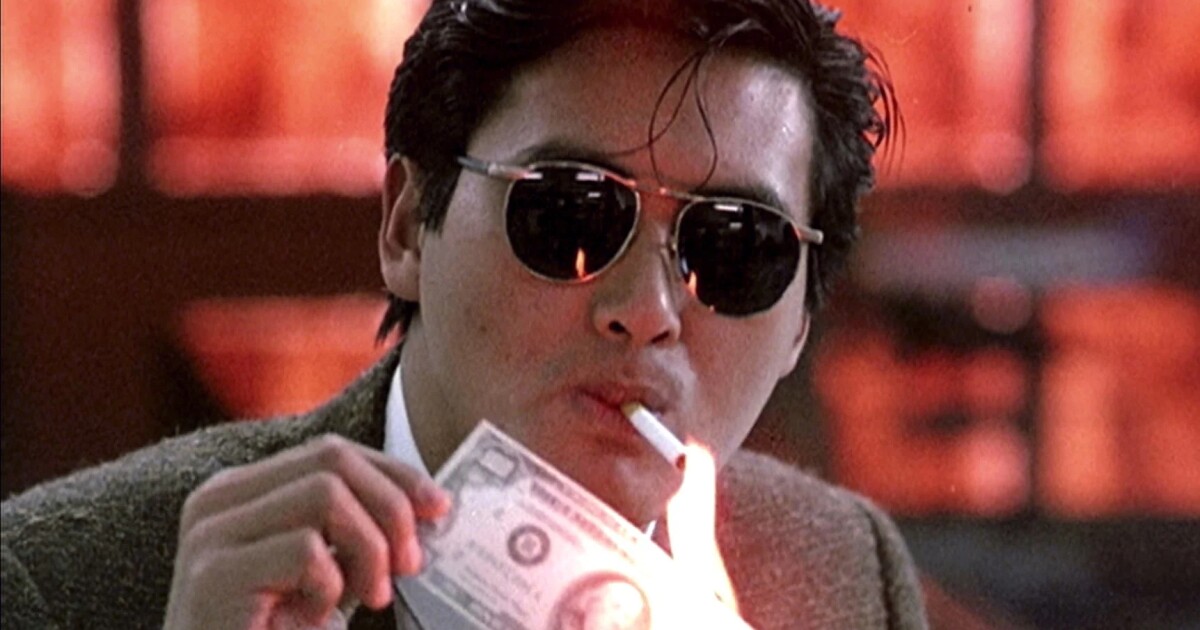
Action cinema would not be the same without John Woo. He helped launch the Hong Kong New Wave of the 1980s with “A Better Tomorrow,” “The Killer” and “Hard-Boiled.” All three films have been given new 4K restorations by Shout Studios for its Hong Kong Action Classics collection, with all three titles not only available on Blu-ray for home entertainment shelves but also back on the big screen where they belong.
For Midday Movies, Yazdi Pithavala of Moviewallas Podcast and I sing the praises of John Woo. But I want to pay tribute to Woo beyond our discussion.
Directed by John Woo
Longtime fans know that if you give Woo an action scene, he’ll turn it into something so deliriously cinematic that you’ll feel guilty deriving pleasure from something so violent. If you give him a formula film, he’ll turn conventions on their ear and deliver complexity and emotion where you least expect it. And if you give him free rein, he’ll blow the competition away. But according to Woo, that’s simply “the character of the Hong Kong movie, always trying to give you a lot of different surprises. I always like to try to create something new, something unexpected, something unusual and to give the audience a big surprise. I hate to play by the rules.”
Not playing by the rules has made Woo a hot property, with an international reputation for over-the-top filmmaking. Woo’s innovative and exhilarating style caught Hollywood’s eye, and he came over here in 1992 to direct the Jean-Claude Van Damme film “Hard Target.” In 1996, he made “Broken Arrow” with John Travolta and proved that his Hong Kong style had U.S. box office appeal. And then he followed strongly with “Face/Off” in 1997, the year Hong Kong reverted to Chinese rule.
Woo defined heroic bloodshed cinema and won acclaim with films like “A Better Tomorrow,” and then secured an international reputation with “The Killer” and “Hard-Boiled.” All three films starred the charismatic Chow Yun-Fat as a romantic, modern-dress version of the Chinese warrior. He sometimes came from the wrong side of the tracks, but he always stood for honor, loyalty and friendship.
In person, Woo is an exceedingly gracious and charming man. His quiet, serious demeanor offers a sharp contrast to the in-your-face flamboyance of his movies. If you met him at a cocktail party, you’d never guess the kind of films he makes. But what is consistent with his films is his deep sense of passion. I had the honor of interviewing him multiple times. He talked about growing up in a slum surrounded by violence but firmly believing that there’s a better world out there.

Woo began making experimental films at the age of 19. By 1971, he was working for the Shaw Brothers and eventually joined Golden Harvest in 1973. Initially, he made kung fu movies and comedies, but all that changed in 1986 when he teamed with producer Tsui Hark to make “A Better Tomorrow,” a Hong Kong gangster film that shot Woo and his star Chow to stardom. But Woo hasn’t forgotten his roots in comedy and often endows his films with self-deprecating and sometimes unexpected humor.
The holy trinity of action films
Here are three defining moments from his newly restored films, moments that made me fall in love with his movies.
In “A Better Tomorrow” (1986), a man and woman glide down a hallway in slow motion. The camera tracks with them as the man embraces and kisses the woman. Then we notice that the man is dropping a loaded gun in each of the potted plants they pass. The sensuous slow motion now takes on a different tone as we realize that violence, and not sex, is on the man’s mind. At the end of the hall, he parts company with the woman, draws two guns and blasts away at the men who just betrayed his friend. Then he tosses his guns aside and leaves the room. When he’s followed, he simply pulls out the previously planted guns and riddles his enemies with more bullets.
Quentin Tarantino famously said, “Yeah, he can direct an action sequence — and Michelangelo could paint a ceiling.”
In “The Killer” (1991), a hitman (Chow again) has just executed a contract. He drops his gun and then notices one of his victim’s associates going for a weapon. Coolly, he surveys the room, eyes a gun on the table, kick-flips the table and sends the gun into the air. In slow motion, we see the gun fly into his hand so he can dispose of his attacker without missing a beat. This scene also sets the stage for the emotional drama to follow as Chow’s character seeks to atone for his sin of blinding the singer. That’s another key aspect of Woo’s films: a sometimes heartbreaking sense of emotion. That is especially true in another of his films, “Bullet in the Head.”
The film was a homage to Jean-Pierre Melville’s “La Samourai,” which starred Alain Delon, and it had a flagrant romanticism in its portrait of a soulful paid assassin. Chow gives the character a supreme sense of cool, a melancholy edge and an unexpected heroic dimension. Side note: In the earlier “A Better Tomorrow,” Chow sported Alain Delon sunglasses and sent sales for them through the roof. Delon sent Chow a thank-you note.
In “Hard-Boiled” (1992), a cop slides down a banister while firing a pair of guns at some hoodlums. Then he returns upstairs to pursue another gunman through a kitchen. He dives over a table and lands in the killer’s face. With his gun poised at the man’s forehead, he fires a shot, splattering blood over his own flour-covered face.
Woo initially was called “an Asian Sam Peckinpah” as well as a “Hong Kong Martin Scorsese.” But now he is beyond such comparisons. The scenes exemplify Woo’s violent, innovative and exhilarating filmmaking style. These films, along with “Bullet in the Head” and the light-hearted “Once a Thief,” established Woo as a director of grace, passion and hyper-kinetic energy. Quite simply, there’s no one who can deliver the goods like Woo.
Concerned that the kind of films he made might get him into trouble when Hong Kong returned to mainland China in 1997, Woo decided to emigrate to the U.S. in 1992.

Despite all the acclaim he had won, Woo’s Hong Kong films were not widely available in the U.S. Filmgoers wishing to see his films on the big screen had to search out Asian film theaters or watch art house calendars for Hong Kong film festivals. His films were even difficult to find on video, and when you could find them, the versions were often unsatisfactory. Take, for instance, the old Fox Video release of “Hard Boiled” — badly dubbed, not letterboxed and should be avoided.
Woo described himself as an action director who “cares about people.” He noted that he has never shot a gun and that he hates violence and war. Yet he confesses that he derives sheer joy from shooting an action sequence. It’s this joy that Woo feels over the very possibilities of filmmaking that make his films such an intoxicating cinematic experience for viewers.
Woo approaches screen violence the same way he approaches everything else in his films: with a burning desire to bring something new and exciting to the medium. He looks at each new scene like a painter facing a blank canvas and wanting to cover it with bold, inventive strokes. A key influence for him were MGM musicals he watched growing up.

“Whenever I am choreographing the action sequence I still feel I am choreographing a dancing sequence,” Woo said in a 2009 interview with me. “I am so concerned about the rhythm of the action and the beauty of the body movements that it’s like a dance. So yes, it still gives me a lot of influence.”
If you have not had a chance to see any of Woo’s films, don’t miss the opportunity to check out “A Better Tomorrow” in theaters this Sunday and Monday, and “The Killer” coming in April.
Source link
